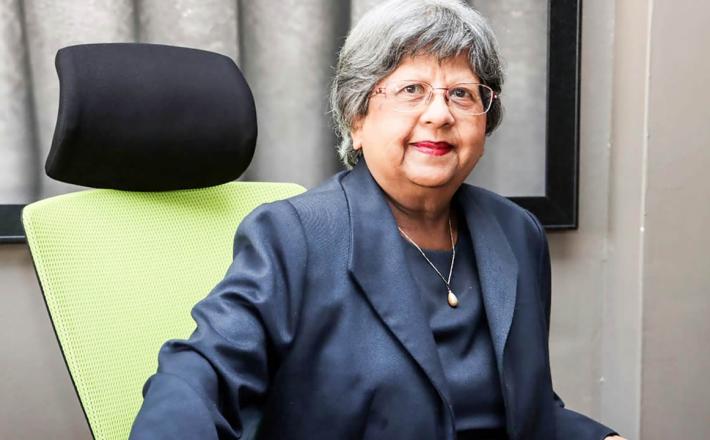
Shirin Aumeeruddy-Cziffra
Presently the Speaker of the National Assembly in Mauritius. But I have been a Member of Parliament from 1976 to 1990. And then I quit politics and I was also an ambassador. I've done quite a few things. But I'm A feminist, that's the most important. I'm a feminist of the 1970s. when we were just starting to talk about women's rights. When we had the first women's conference in Mexico, I had just finished my studies. I'm a lawyer by training. And it was like I fell in it. And then we were everywhere. We went around the world talking to women, trying to understand why so few women are in leading positions, both in the public sector and in the private sector. So now we've made a lot of progress in many countries, but there's still quite a lot to do.
What are the main barriers preventing women from diverse backgrounds from participating in politics?
I think women are normally seen as mothers. Not all women want to be mothers, but we are, many of us. We choose to be mothers. And we are not only just looking after our children, but we look after old people. Women are seen to be caregivers, generally speaking. And we're not seen as people who can actually play a very important position, whether as a parliamentarian or as a minister or as a speaker. You see, so it takes a lot of time to break all these, all these stereotypes about women being made for such and such a thing or men being made for such and such a thing. I was very lucky because my husband looked after the kids while I was, you know, running around in my constituency. But most men don't want to do that. They cannot do that.
So in the olden days, we used to leave the kids with the grandmothers. But now grandmothers are also working. So where do you leave the kids? So basically society is not organized in such a way as you will be able to, for example, go to work and in your workplace have a place where you can put the baby, which is not so difficult, but we keep talking about it and it's still not quite the norm.
So how can we expect most women to come into politics? Because it is the same age, when we're going to have children, that in fact we're starting a new career perhaps, and at the same time we're going to start a political career. It's very difficult. So there must be a bit, like I do, role model, and we tell them, you know. We don't need to be extra special to be a member of Parliament.
What changes are necessary to increase women’s presence in parliament?
You have to be close to the people. And who better than a woman is close to the people? So we have to tell them what are their qualities, what are maybe some of the difficulties they will face, try and reassure them and train them. But we also must train the men. Because in order to get the women in Parliament, we must ask the men to give some space. And also, perhaps, get them to, we're trying, right now I'm going to try and get them to do something for the women who have children. Because if they have, because you sit long hours, sometimes we do night sittings. So women are not quite convinced. You know, they're not sure that is really what they want to do.
Why does diversity in parliament matter?
Yeah, we should talk of diversity, both in terms of gender, but also within the gender itself, have women from all walks of life, have men from all walks of life, and different, being, in different professions, having different specialties, because basically if you're a democrat, you want to have a parliament which is balanced.
If it's not balanced, you can't have a good parliament.
What would you say to inspire more women to get involved in politics?
I think women should believe in themselves. We need self-confidence.
Self-confidence is the really key word for a woman to get somewhere in any profession and of course in public life.
Presently the Speaker of the National Assembly in Mauritius. But I have been a Member of Parliament from 1976 to 1990. And then I quit politics and I was also an ambassador. I've done quite a few things. But I'm A feminist, that's the most important. I'm a feminist of the 1970s. when we were just starting to talk about women's rights. When we had the first women's conference in Mexico, I had just finished my studies. I'm a lawyer by training. And it was like I fell in it. And then we were everywhere. We went around the world talking to women, trying to understand why so few women are in leading positions, both in the public sector and in the private sector. So now we've made a lot of progress in many countries, but there's still quite a lot to do.
What are the main barriers preventing women from diverse backgrounds from participating in politics?
I think women are normally seen as mothers. Not all women want to be mothers, but we are, many of us. We choose to be mothers. And we are not only just looking after our children, but we look after old people. Women are seen to be caregivers, generally speaking. And we're not seen as people who can actually play a very important position, whether as a parliamentarian or as a minister or as a speaker. You see, so it takes a lot of time to break all these, all these stereotypes about women being made for such and such a thing or men being made for such and such a thing. I was very lucky because my husband looked after the kids while I was, you know, running around in my constituency. But most men don't want to do that. They cannot do that.
So in the olden days, we used to leave the kids with the grandmothers. But now grandmothers are also working. So where do you leave the kids? So basically society is not organized in such a way as you will be able to, for example, go to work and in your workplace have a place where you can put the baby, which is not so difficult, but we keep talking about it and it's still not quite the norm.
So how can we expect most women to come into politics? Because it is the same age, when we're going to have children, that in fact we're starting a new career perhaps, and at the same time we're going to start a political career. It's very difficult. So there must be a bit, like I do, role model, and we tell them, you know. We don't need to be extra special to be a member of Parliament.
What changes are necessary to increase women’s presence in parliament?
You have to be close to the people. And who better than a woman is close to the people? So we have to tell them what are their qualities, what are maybe some of the difficulties they will face, try and reassure them and train them. But we also must train the men. Because in order to get the women in Parliament, we must ask the men to give some space. And also, perhaps, get them to, we're trying, right now I'm going to try and get them to do something for the women who have children. Because if they have, because you sit long hours, sometimes we do night sittings. So women are not quite convinced. You know, they're not sure that is really what they want to do.
Why does diversity in parliament matter?
Yeah, we should talk of diversity, both in terms of gender, but also within the gender itself, have women from all walks of life, have men from all walks of life, and different, being, in different professions, having different specialties, because basically if you're a democrat, you want to have a parliament which is balanced.
If it's not balanced, you can't have a good parliament.
What would you say to inspire more women to get involved in politics?
I think women should believe in themselves. We need self-confidence.
Self-confidence is the really key word for a woman to get somewhere in any profession and of course in public life.